

The short answer
Hail damage on a car is repaired in stages. The vehicle is inspected under reflection lighting and every dent is counted panel by panel. The insurer's adjuster writes an estimate, and supplements add damage found later. Each panel then gets its own method: paintless dent repair, glue pulling, push-to-paint or replacement. Trim, lamps or the headliner come off for access, the dents are repaired, and the work is checked under lighting before cleanup and delivery.
 Written by the DentPicks Editorial Team
Technically reviewed by Vytas Kucinskas, Founder & Master PDR Technician
Written by the DentPicks Editorial Team
Technically reviewed by Vytas Kucinskas, Founder & Master PDR Technician
Published: Oct 1, 2026 · Last reviewed: Oct 1, 2026 · 10 min read
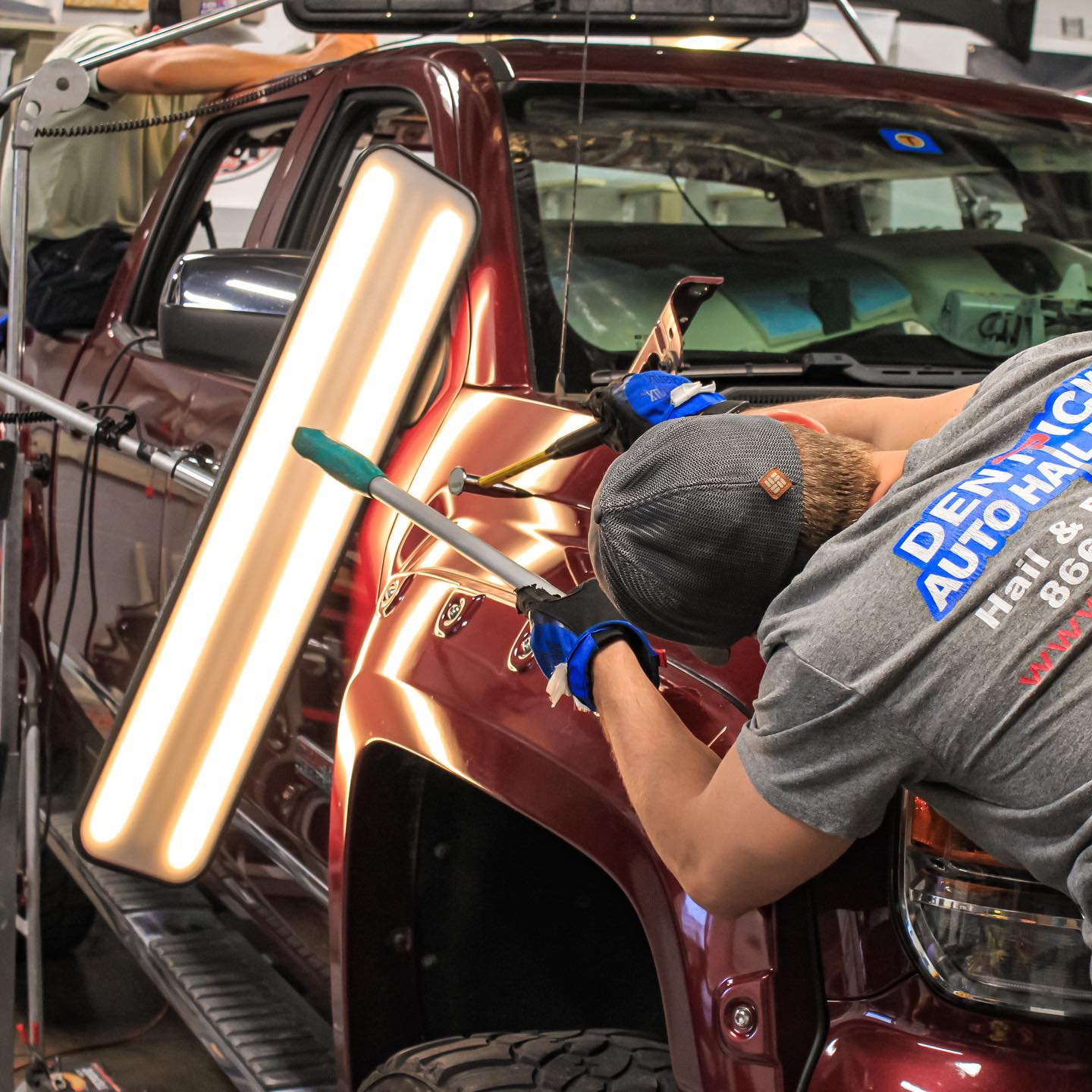
Most explanations of hail repair zoom straight in on a single dent: a rod behind the panel, a light overhead, metal moving back into place. That is the core skill, and our guide on how paintless dent repair works covers it in detail. But nobody brings in a car with one hail dent. A hailed vehicle arrives with damage on the hood, roof, rails, decklid and often the sides, and fixing it is a project with a sequence — some steps decided by the metal, some by the insurer, some by the car's own construction.
This guide follows the whole vehicle through eight stages, from the first look under lighting to the moment you drive away. The order matters: a shop that starts repairing before the car is fully mapped, or before each panel's method is settled, hits surprises halfway through.
Stage 1: Inspection under lighting and the dent count
Everything downstream depends on an accurate map of the damage, and that map cannot be made in a driveway. Hail dents are shallow and have no color of their own; they only show up as distortions in a reflection. So the car comes inside, is cleaned enough to reflect properly, and goes under LED line boards. A technician works around the vehicle one panel at a time and records how many dents each panel carries and how large they are.
The same pass looks for anything that changes the plan: chipped or cracked paint inside a dent, metal stretched by large stones, dents on a body line or panel edge, signs of an earlier repaint or filler, and damage to glass, lamps, mirrors, moldings and seals. Dash warnings get noted too, because sensors live in many of the panels hail strikes.
You should come away with a panel-by-panel damage list, photographs and a straight view on whether a claim is worth filing. Our guide to what a hail damage inspection includes lists every item. For a first read, photos sent through the quote form usually produce a verbal figure in about 30 minutes, but photos undercount a dent field, so the repair is planned from the in-person read.
Stage 2: Estimate, adjuster and supplements
For most hailed cars the repair is paid under the comprehensive part of an auto policy, so the insurer has to agree on scope before work starts. You report the claim to your insurer, and the carrier's adjuster inspects the car and writes an initial estimate. DentPicks walks alongside you through it: photos, meeting the adjuster, supplements and paperwork. The Texas Department of Insurance guidance after hail and windstorms is worth reading before that conversation.
Expect the first estimate to differ from the shop's count. Dents hidden behind moldings or visible only under line boards are easy to miss in an outdoor inspection. The correction is a supplement: the shop documents what was found, sends the evidence to the carrier, and the adjuster reviews it. That is routine on full-vehicle hail claims; our explainer on insurance supplements in hail repair covers how it moves. Also check who the payment names — checks can list you, the shop and any lienholder, and our guide to repair authorization and direction to pay explains what you are signing.
Paying out of pocket instead? The same inspection feeds a cash quote, built from dent count, dent size, panel size and access. How full-vehicle hail repair is priced walks through those inputs.
Stage 3: Choosing the method for each panel
A hailed car is rarely repaired one way from bumper to bumper. Each panel gets its own decision, following the condition of that panel rather than a preference for one technique. In rough order of preference:
| Method | When it fits a panel | What it means for the finish |
|---|---|---|
| Paintless dent repair (rods) | Paint intact, metal not badly stretched, a tool path to the back of the dent | Factory paint stays on the panel |
| Glue pulling | Paint sound but no rod access, such as dents over roof bows or inside boxed sections; also used to lift depth before rod finishing | Factory paint stays, provided it is healthy enough to release the adhesive cleanly |
| Push-to-paint | Metal can be reshaped but the paint is already cracked or chipped, or a crease is too sharp for paint to follow | Metal straightened first, then the panel is primed and refinished |
| Replacement | Torn metal, stretch beyond recovery, a ruined finish over a wide area, or no way to reach the damage | New panel, refinished to match |
It is normal for one vehicle to use three of these: rods on the hood and doors, glue on parts of the roof, and a replaced or refinished panel where the paint broke on impact. Our guides to choosing between PDR, push-to-paint and replacement, glue pull repair and when replacement beats PDR explain each call. If an insurer requires replacement rather than paintless work, ask what that means for the vehicle's history record before you agree.
Stage 4: Getting access — trim, lamps and the headliner
Rod work needs a path to the back of each dent, so a full-vehicle hail job involves careful disassembly: door panels, taillamps and inner liners for the quarters, liftgate trim, roof rails and moldings, and for some roofs the headliner lowered at one edge. Removing a molding also exposes dents hidden behind it, which is one reason supplements tend to appear in the first day or two in the shop.
This is where careless work causes problems that have nothing to do with hail: broken clips, rattles, a disturbed curtain airbag harness, a pinched sunroof drain. A methodical shop records what comes off, replaces one-time-use clips rather than forcing old ones back in, and stores parts by panel. See trim removal during paintless dent repair and roof hail repair without headliner damage. Where a removed sensor or camera needs recalibration, DentPicks has it done to manufacturer procedure by a qualified calibration provider.
Stage 5: The repair itself
With the plan set and the panels opened up, the metalwork begins. On a heavily hailed car this is the longest stage by far, because every dent is worked individually under the light. The roof and hood usually carry the most damage, since they face the sky; doors and quarters join the list when the storm was wind-driven.
Panels that will be refinished or replaced follow a different path. Push-to-paint panels are straightened by the dent technician first, then go to prep and refinishing; replacement panels are ordered, fitted and painted to match. When some panels keep factory paint and others are refinished, the plan should account for how the new finish sits next to the original — another reason to know which route each panel took.
Things can change mid-repair. A dent that read as clean can reveal a hairline in aged clearcoat as it moves, or metal can prove more stretched than it looked. When that happens the panel's method changes, the finding is documented, and on a claim it goes to the carrier as a supplement. You should hear about it rather than discover it at pickup; at DentPicks you get live updates in your customer portal. See paint cracks during or after dent repair.
Stage 6: Quality control under reflection lighting
A repair that looks flat in the bay may not look flat in a sunny parking lot, so finished panels are read again under reflection lighting, close up and from a few steps back, for leftover lows, high spots, tool marks, glue residue and waviness along body lines. Our guide on why repairs are checked under reflection lighting explains what that light reveals that daylight does not.
Quality control also covers reassembly: trim seated, clips secure, the headliner tight, lamps and windows working, no warning lights, and no new noises on a short drive. What a PDR quality control check includes has the full list. At DentPicks the finished vehicle is signed off by whoever runs quality control before release, and that sign-off is recorded in your customer portal.
Stage 7: Cleanup and delivery
Glue residue is cleaned off, and DentPicks vehicles go back after a mini exterior detail. On insurance-approved hail claims in DFW, complimentary pickup and a loaner are offered, so delivery may happen at your home or office. Take a few minutes over the handover:
- Look at the panels under the shop's lighting, especially the roof and hood.
- Operate what was disassembled: windows, locks, mirrors, the sunroof, the liftgate.
- Check the dash for warning lights after a restart.
- Collect the paperwork: the final invoice, supplement records, calibration documents if any, and your warranty terms.
DentPicks repairs carry a written lifetime warranty for as long as you own the vehicle; it is not transferable and covers the repair, not new damage, so read your own written terms. Our five questions to ask at vehicle pickup pair well with that walk-around.
Stage 8: How long the whole thing takes
There are two clocks. The insurer's covers claim reporting, the adjuster inspection and supplement approval, and it slows after big regional storms. The shop's starts once the claim is approved and the car is in: a typical full-vehicle hail repair at DentPicks runs about 5–10 business days. That is a range from our own repair history, not a promise; deep roof damage, refinish work or backordered moldings can push past it. Our guide to how long hail repair takes breaks the calendar down further.
Where hail repairs commonly go wrong
- Repairing from an outdoor count. Starting work on an estimate that missed half the dents leads to rushed supplements or skipped damage.
- One method for every panel. Forcing paintless repair onto a cracked panel, or repainting a panel that could have kept its factory finish, are both planning failures.
- Rushed disassembly. Broken clips and loose trim become rattles weeks later.
- No second look. A car released without an independent check under reflection lighting is only as good as one person's last pass.
- Silence. If you cannot find out which stage your car is in, ask why.
What to do next
If your car was hailed, photograph it where it sat, report the claim to your insurer, and get the panels read under lighting before anyone commits to a method or a number. DentPicks inspects hail damage free at the Plano shop, and our hail repair service page explains how we handle each of these stages. If you want a starting figure first, send photos through the quote form.
Frequently asked questions
Can I fix hail damage on my car myself?
Not to a standard you would accept. DIY suction cups, dry ice and hair-dryer methods rarely move hail dents fully and can stretch the metal or crack aged paint, which can turn a paintless repair into a refinish job. A free inspection under lighting tells you what you actually have before you try anything.
Is every panel on a hailed car repaired the same way?
Usually not. Each panel gets its own decision based on paint condition, metal stretch, access to the back of the panel and prior repairs. One car commonly mixes rod work, glue pulling and, where the paint broke or the metal tore, refinishing or replacement. Ask the shop for the method by panel.
Do I need an adjuster inspection before the repair starts?
On an insurance claim, yes — the carrier needs to agree on scope before it pays. You report the claim to your insurer; the adjuster inspects the vehicle and writes the initial estimate. Damage found afterward, often behind trim or under shop lighting, goes back to the carrier as a supplement.
Will the shop need to remove my headliner?
Sometimes. Many roof dents are glue pulled from outside or reached through existing openings such as the sunroof aperture or dome light. Deeper roof damage may need the headliner lowered at one edge, which is normal work when clips, drains and airbag wiring are handled properly.
How long does whole-car hail repair take?
At DentPicks a typical full-vehicle hail repair runs about 5–10 business days in the shop once the claim is approved. That is a range from our own repair history, not a promise. Insurer response, supplements, refinish work and backordered moldings can all extend it.
How do I know the repair was done properly?
Look at the panels under the shop's reflection lighting before you sign for the car, and operate everything that was taken apart. At DentPicks the finished vehicle is signed off by whoever runs quality control, and that sign-off is recorded in your customer portal.
Sources and methodology
- After hail or windstorms: consumer tips — Texas Department of Insurance.
- Auto insurance guide — Texas Department of Insurance.
- NWS Fort Worth/Dallas forecast office — National Weather Service.
Repair, cost and timing statements that are not tied to a listed source come from DentPicks' own quoting and repair history at the Plano, TX shop. They are typical ranges and shop-floor observations, not industry statistics or promises — your vehicle, its condition, your policy language and your insurer determine your specific outcome.
Want your hail repair mapped panel by panel?
Bring the car to Plano for a free read under PDR lighting, or send photos through the form for a verbal figure, usually back in about 30 minutes.