The short answer
Yes, for most dents. Paintless dent repair keeps the factory paint because nothing is sanded, filled or resprayed, and on intact paint with good panel access it is very low risk. The real risks are cracked paint on deep dents or aged clearcoat, over-pushed high spots, stretched metal that never fully settles, edge and aluminum damage, problems on previously repainted panels, and parts damaged during disassembly. A careful indoor assessment under reflection lighting identifies most of them before work begins.
 Written by the DentPicks Editorial Team
Technically reviewed by Vytas Kucinskas, Founder & Master PDR Technician
Written by the DentPicks Editorial Team
Technically reviewed by Vytas Kucinskas, Founder & Master PDR Technician
Published: Oct 1, 2026 · Last reviewed: Oct 1, 2026 · 11 min read
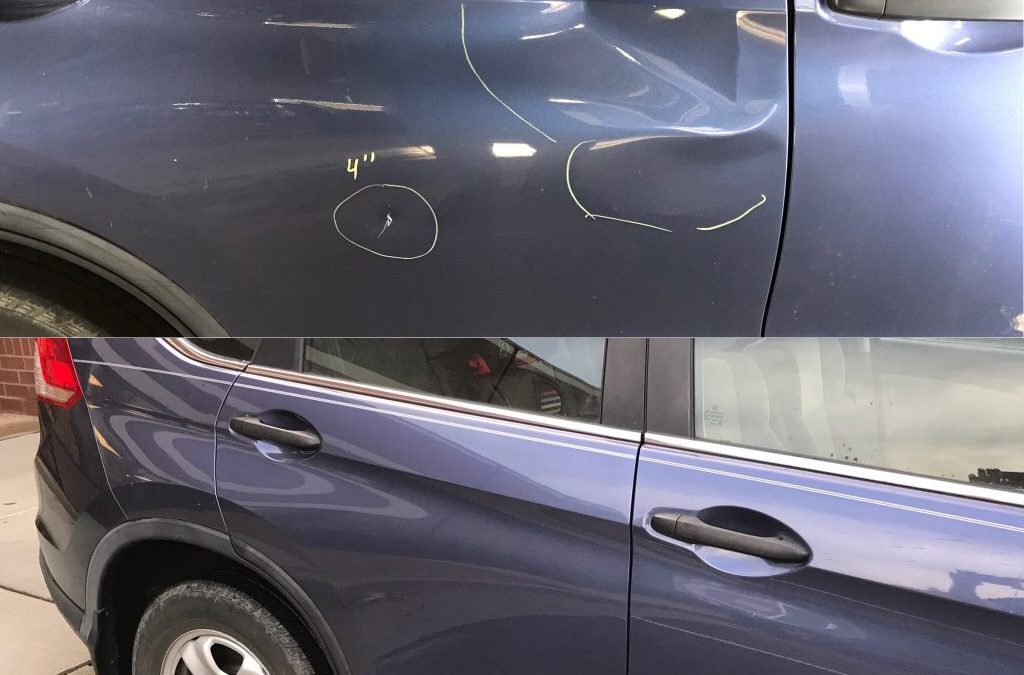
"Is it safe?" is really three questions bundled together. Will it hurt my paint? Will it hurt anything else on the car? And will I end up worse off than if I had left the dent alone or gone to a body shop? Paintless dent repair holds up well on all three for the majority of dents — but not for every dent, every vehicle or every technician, and the exceptions are exactly what this guide is about.
Our explainer on how paintless dent repair works covers the technique. This page lists the specific ways a PDR job can go wrong, what makes each more or less likely, and which questions to ask before you approve the work.
Is PDR safe for paint and the factory finish?
For most dents, yes. Nothing is sanded, filled or sprayed, so the coating that leaves the shop is the same coating that came from the factory. The method depends on paint that bent with the metal on impact and stayed bonded; when that is true, the metal can be walked back slowly and the finish follows it.
The honest qualifier is that paint has limits. Across the repairs that come through our Plano shop, cracking during repair happens in roughly one in a hundred jobs, and it is not random. It concentrates on deep, sharp dents in older or sun-baked clearcoat and on panels that were resprayed at some point. Broad, shallow dents in healthy original paint almost never give trouble. So the useful question is not "can PDR crack paint?" but "is my particular dent in the higher-risk group?" Our guide to paint cracks during or after dent repair covers how that risk is assessed and what happens if it occurs.
Glue pulling, the front-side method used where a rod cannot reach, adds one more consideration: the adhesive releases cleanly from sound factory paint, but a weakly bonded respray can lift with the tab.
The real risks, and where each one comes from
Most PDR problems trace back to one of three sources: the dent itself, the vehicle it is on, or the person doing the work. Only the last one is fully in your control, through the shop you choose.
| Risk | What it looks like | Main driver |
|---|---|---|
| Cracked paint | A hairline or small star at the deepest point of the dent | Dent depth and paint age |
| Over-pushed high spots | A raised bump or wavy ring where the dent used to be | Technician control |
| Stretched metal that will not settle | A soft, slightly oil-canned area that never reads perfectly flat | The original impact |
| Edge and body-line limits | Visible improvement but a faint residual mark | Panel construction |
| Aluminum panel setbacks | Slower progress, more chance of lows and highs | Panel material plus technician experience |
| Repainted or filled panels | Paint lifting, filler cracking under the surface | Earlier repairs |
| Disassembly damage | Broken trim clips, warning lights, rattles, misaimed sensors | Access method and care |
Risks that come from the dent
Stretched metal. A hard, sharp impact thins and lengthens the steel or aluminum at the point of contact. That extra material has nowhere to go, so even a skilled technician may bring the area very close to flat without making it perfect. This is a limit of the damage, not a failure of the repair, and you should hear about it before work begins. What stretched metal means in dent repair explains how it is judged.
Edge and crease damage. Dents on a folded panel edge or across a sharp body line are among the hardest to finish invisibly, because the metal is double-thick or highly formed and there is often no space behind it for a tool. Strong improvement is common; a guaranteed perfect result is not. See why panel edge dents are harder to repair and PDR on deep creases and large dents.
Risks that come from the vehicle
Aluminum panels. Many hoods, doors, tailgates and entire truck bodies are now aluminum, a shift the U.S. Department of Energy describes in its overview of lightweight materials for cars and trucks. Aluminum is repairable with PDR, but it has less "memory" than steel, can work-harden and is easier to overcorrect. It usually needs more time, controlled warming and a technician who works aluminum regularly. Our page on aluminum dent repair goes deeper.
Previously repaired panels. A respray may have weaker adhesion than factory paint, and body filler underneath is rigid — it cracks instead of flexing when the metal moves. Prior repairs are the most common reason a dent that looked like a simple PDR job turns into something else. Read PDR on a previously repainted panel before approving work on any car with an unknown history.
Electronics behind the panels. Doors carry airbag sensors, window motors and wiring harnesses; bumpers and mirrors hold parking sensors, radar units and cameras. Reaching the back of a dent sometimes means removing a door card, tail light or trim piece, and that is where things get unplugged, pinched or knocked out of alignment. See airbags and wiring in door dent repair and PDR and parking sensors, cameras and ADAS.
Risks that come from the technician
Over-pushing. The most common avoidable defect is a high spot: metal driven past its original contour by too much pressure in one place. Mild highs can be tapped back down, but repeated overcorrection can stretch metal that was not stretched before, and cracked clearcoat over a high spot is no longer a PDR fix. Our guide to high spots, low spots and tool marks shows what to look for.
Inexperience and poor setup. Working outdoors without a reflection board, rushing a hail car to hit a volume target, prying trim without the right tools, or pushing cold metal on an aged finish — these are where most preventable PDR damage starts. Texas does not license dent repair technicians, so "certified" on its own tells you little; see what PDR certifications or experience to verify. After a big storm, the Texas Department of Insurance also cautions drivers about out-of-town repair operators in its after hail or windstorms tips. If an earlier repair went badly, re-repairing poor-quality PDR work explains what can still be fixed.
Disadvantages and limits, even when nothing goes wrong
Some drawbacks are not risks at all — they are simply the edges of what the method can do.
- Not every dent qualifies. Cracked or chipped paint, torn metal, plastic or heavily filled panels, and dents with no workable access either rule PDR out or reduce it to a first step before paint. How technicians decide if a dent is repairable lays out the criteria.
- It cannot fix paint. If the coating is already broken, PDR can reshape the metal but someone still has to refinish the surface — the combination explained in what push-to-paint repair is.
- It costs more than a DIY kit. A suction cup or glue-puller kit is cheaper up front, but a failed attempt can crack the paint or stretch the panel and turn a modest PDR job into a refinish. See why DIY dent tricks usually fail and the PDR cost guide.
- It takes real time on hail cars. A single door ding is often finished in hours, but a full hail repair means hundreds of individual dents. Expect days, and longer after a major storm when North Texas shops are booked.
- Access sometimes means disassembly. Trim, lights or headliners may come off and go back on. That is normal, which is why the care of the person doing it matters. See why trim is sometimes removed during PDR.
- Photo estimates are approximate. Photos flatten depth and hide prior repairs, so a figure based on pictures can move once the car is under lighting. That is not a trick; it is the limit of a picture.
How to reduce the risk before you approve a repair
Most of the risk in PDR is decided before the first push. These steps cost nothing and screen out most of the bad outcomes above.
- Insist on an indoor read under reflection lighting. Depth, sharpness, stretch and prior repairs show up under a line board, not in a parking lot at noon.
- Ask which dents are higher-risk, by name. A careful technician will point to the specific dents near edges, on body lines, in aged paint or on resprayed panels and tell you what to expect from each.
- Ask what will be removed for access. If a door card, bumper cover or tail light is coming off, ask how electrical connections are handled and whether sensor calibration may be needed afterward.
- Ask what happens if paint cracks. The answer should include a repair path and who pays. On an insurance claim, added work is normally handled through a supplement; you file the claim and the shop documents the extra work. Your insurer or licensed agent can confirm your coverage, and the TDI auto insurance guide explains how Texas auto policies generally work.
- Get the warranty terms in writing. DentPicks repairs carry a written lifetime warranty for as long as you own the vehicle; it is not transferable and covers the repair rather than new damage. Check your own written terms with any shop you use.
- Inspect the result in good light before you drive away. Look at each repaired area at an angle against a straight reflection and raise anything wavy while you are still there.
When something other than PDR is the safer choice
The safest repair is the one that matches the damage. Panels sometimes do need to be repainted or replaced — when paint is broken across a wide area, when metal is torn, when filler fills most of the dent, or when an insurance adjuster determines a panel must be replaced. A shop that never recommends anything except PDR is ignoring part of the picture. When panel replacement beats PDR and PDR vs. a traditional body shop compare the options.
The bottom line
Paintless dent repair is a low-risk repair for paint-intact dents on accessible panels, done indoors by someone who reads the metal under proper lighting and tells you the limits up front. The real risks — cracked paint, high spots, stretched metal that will not fully settle, edge damage, aluminum, earlier repairs and disassembly mistakes — are known and mostly predictable. The safeguard is an honest assessment before the work, not a promise after it.
To find out which group your dent falls into, start with a photo estimate through our quote form, or bring the car in for a read under the lights. Our paintless dent repair service in Plano will tell you plainly whether PDR is the right repair and where the risk sits on your panels.
Frequently asked questions
Can paintless dent repair damage my car?
It can, but the ways it goes wrong are specific and mostly predictable: paint cracking on deep or sharp dents in aged clearcoat, high spots from too much pressure, and broken clips or unplugged connectors when trim is removed for access. On paint-intact dents with good access, worked indoors under proper lighting, the risk is low.
How often does PDR crack the paint?
In our Plano shop experience, roughly one in a hundred repairs, concentrated on deep or sharp dents in older or sun-damaged clearcoat and on resprayed panels. Shallow dents in healthy factory paint rarely crack. If it happens, the panel moves to localized paint repair or refinishing rather than being left damaged.
What are the main disadvantages of paintless dent repair?
It cannot fix broken paint, not every dent qualifies, some damage on edges, body lines or stretched metal can only be greatly improved rather than made invisible, full hail repairs take days, and access sometimes requires removing trim or lights. It also costs more up front than a DIY kit, though a failed DIY attempt often costs more in the end.
Is PDR safe on aluminum panels?
Yes, when done by someone who works aluminum regularly. Aluminum is less forgiving than steel: it is easier to overcorrect, can work-harden and usually needs more time and controlled warming. Expect a slower repair and ask the technician directly about their aluminum experience before approving the work.
Can PDR affect airbags or sensors?
The repair itself does not, because it only reshapes metal. The risk comes from disassembly — door cards, bumper covers, tail lights or mirrors removed to reach a dent. Ask what will come off, how electrical connections are handled, and whether your vehicle may need sensor calibration afterward.
Does PDR weaken the metal?
Done properly, no. The technician returns the panel to its original shape rather than adding filler or cutting anything away. What can leave a weak or wavy area is repeated overcorrection, which stretches metal that was not stretched before — one reason technician skill and patience matter more than speed.
Is PDR safe on a car that has been repainted?
Often, but it carries more risk. A respray may be less firmly bonded than factory paint, and body filler underneath cracks instead of flexing. A shop should check paint thickness and look for prior repairs before starting, then tell you the realistic outcome for that panel.
Sources and methodology
- After hail or windstorms: consumer tips — Texas Department of Insurance.
- Auto insurance guide — Texas Department of Insurance.
- Lightweight materials for cars and trucks — U.S. Department of Energy.
Repair, cost and timing statements that are not tied to a listed source come from DentPicks' own quoting and repair history at the Plano, TX shop. They are typical ranges and shop-floor observations, not industry statistics or promises — your vehicle, its condition, your policy language and your insurer determine your specific outcome.
Want to know if your dent is in the higher-risk group?
Send photos through our quote form for a quick verbal figure, or bring the car to the Plano shop. We will read each panel under the lights and tell you plainly where the risk sits and whether PDR is the right repair.